



You’ve tried resting it. Painkillers barely touch it. Sitting up straighter at your desk hasn’t helped either. Weeks later, the pain in your neck hasn’t moved on, and you’re starting to wonder whether something is actually wrong.
Ordinary muscle strain doesn’t usually last this long. Constant neck pain that persists this way tends to have a specific cause behind it, not just strain that hasn’t settled yet. That changes what happens next.
Direct-answer callout
Why won’t my neck pain go away? Neck pain that continues well beyond the few weeks an ordinary strain usually takes to settle is often driven by a specific structural cause, most commonly a facet joint, disc, or nerve root problem, rather than muscle strain alone. As a practical guide, pain that hasn’t eased noticeably by 6 to 8 weeks, or pain that comes with arm symptoms, is a reasonable trigger to seek a specialist assessment rather than repeating the same conservative measures indefinitely.
TL;DR:
- Neck pain lasting more than 12 weeks is classed as chronic, the one point of real consensus on timing. The earlier it’s reassessed, the sooner the right cause gets found.
- Common causes include facet joint pain, disc problems with nerve involvement, cervicogenic headache, posture-related tension, whiplash, and age-related wear
- Certain symptoms (fever with stiffness, weakness in both arms or legs, loss of bladder or bowel control) need same-day medical attention, not a booked appointment
- Diagnosis relies on history, examination, and sometimes a diagnostic block, not imaging alone
- Treatment is matched to the specific cause rather than defaulting to rest and painkillers indefinitely
What Counts as "Constant" Neck Pain?
There is no single clinical rulebook classifying neck pain by exact week, and no NICE guideline for neck pain exists at all. What is well established, consistent across the International Association for the Study of Pain and NHS patient information, is the chronic threshold. Pain lasting beyond 12 weeks, or three months, is classed as chronic, regardless of what originally caused it.
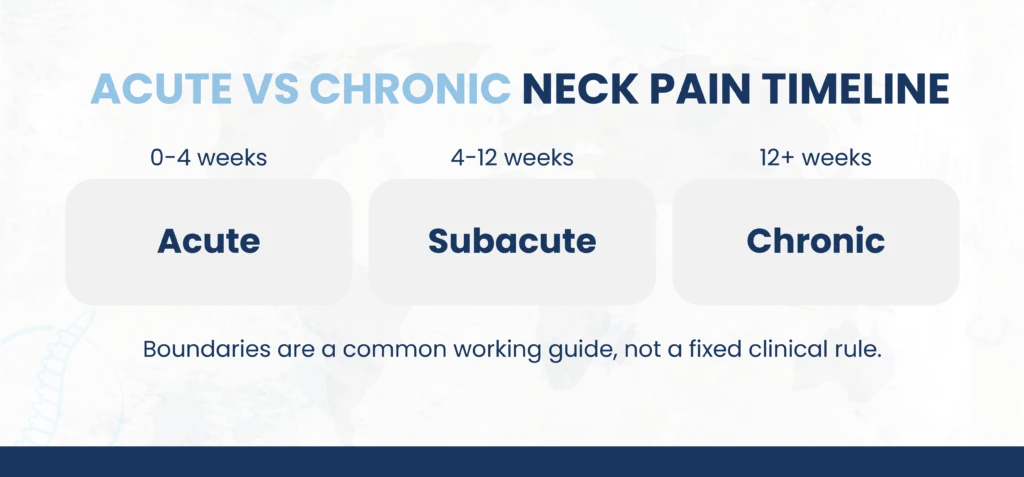
Many clinicians also use an earlier, informal split as a working guide, not a fixed rule:
- Under about 4 weeks, pain is usually acute, and ordinary muscle strain accounts for most cases.
- Between 4 and 12 weeks, pain is subacute. Healing should be well underway by this point, and pain that hasn’t eased starts to warrant closer attention.
- Past 12 weeks, pain is chronic.
This distinction matters in practice. An acute strain and a chronic facet joint problem can feel similar day to day, but they call for different responses. Chasing rest and over-the-counter painkillers well past the subacute stage, without reassessing what’s actually driving the chronic pain, is where most people get stuck.
When to Get Help Immediately
Most constant neck pain isn’t an emergency, and the rest of this guide covers what to do about it. A small number of symptoms do need same-day medical attention rather than a booked appointment.
Call 999 or go to A&E if your neck pain comes with any of the following:
- A fall or direct injury to the neck
- Fever together with neck stiffness
- New weakness, numbness or clumsiness affecting both arms or both legs, which can point to spinal cord compression
- Loss of bladder or bowel control
- A sudden, severe “thunderclap” onset of pain
- Difficulty swallowing or speaking
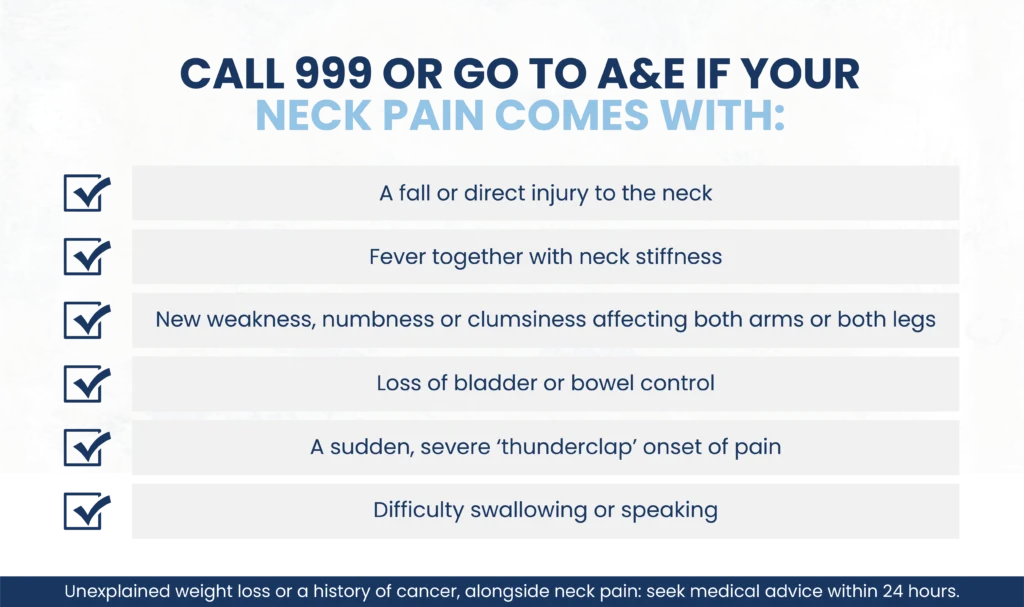
Unexplained weight loss or a history of cancer, alongside neck pain, is handled differently. NICE’s guideline on metastatic spinal cord compression places this on a 24-hour pathway. Advice should be sought within 24 hours where pain has concerning features like this, and it becomes an emergency only if cord-compression symptoms are also present.
These red flags follow NICE Clinical Knowledge Summaries on neck pain, nerve-root pain and whiplash. They are hosted on the NICE website but published independently, under their own licence, and are not NICE’s own clinical guidance. There’s no dedicated NICE guideline for neck pain, which is why Clinical Knowledge Summaries remain the most relevant published reference here, alongside the primary care diagnostic guide published in the British Journal of General Practice.
If none of these apply, it’s still worth understanding what’s likely driving the pain, and when it’s reasonable to see a specialist rather than continuing with rest and painkillers.
What's Actually Causing Your Neck Pain?
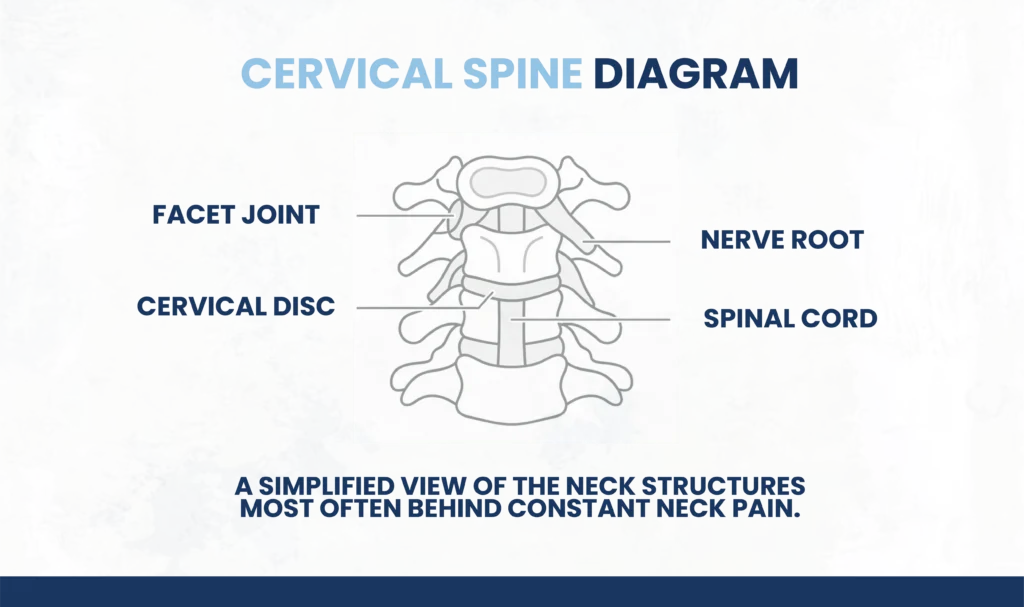
Constant neck pain usually traces back to one of a handful of specific problems. Knowing which one you’re dealing with changes what treatment actually helps.
Cervical Facet Joint Pain
Cervical Disc Problems & Radiculopathy
Discs between the vertebrae can bulge or wear down, sometimes pressing on a nearby nerve root. Pain then often radiates into the shoulder, arm, or hand, with numbness, tingling or weakness along the way. This pattern, cervical radiculopathy, points to the nerve root rather than the joint as the source.
Cervical Myelopathy: Why Some Symptoms Are Emergencies
Cervicogenic Headache
Some headaches start in the neck, not the head. A cervicogenic headache usually originates from the upper cervical joints or muscles, felt at the back of the head and spreading forward, and is easily mistaken for a tension headache or migraine when the neck itself isn’t examined. It happens more often than the label suggests: cervicogenic headache affects roughly 1 to 4.6% of the general population, but 15 to 20% of people with chronic headache specifically. That means something close to one in six people with a chronic headache may actually have a neck problem being treated as a head problem. The occipital nerve, running from the upper neck to the back of the scalp, is often the specific structure involved.
Myofascial & Postural Neck Pain
Sustained poor posture, particularly prolonged screen use, leaves the neck and upper back muscles chronically tight, sometimes called “tech neck.” The trapezius, the large muscle running from the back of the neck to the shoulder, is usually the main one affected. Unlike facet or disc problems, this pain is muscular rather than structural, though it can persist for months if the posture pattern isn’t addressed.
Whiplash-Related Neck Pain
A sudden jolt to the neck, most often from a collision, can injure the joints, ligaments or muscles even with no visible damage on a scan. Pain sometimes settles within weeks, but where a facet joint is involved, it can persist well beyond that. Our guide to whiplash-related neck pain covers this in more detail.
Cervical Spondylosis
Age-related wear affecting the discs and joints of the neck, similar to osteoarthritis elsewhere, becomes extremely common from middle age onward and is often symptom-free. Where it isn’t, it can cause stiffness, localised pain and, less often, nerve-related symptoms.
Why Rest and Painkillers Alone Aren't Working
Rest and over-the-counter painkillers are the right first response to neck pain, and for genuine muscle strain, they’re usually enough. The problem is the same advice often gets repeated well past the point where it’s helping, regardless of what’s actually causing the pain.
If the source is a facet joint, a disc, or a nerve root, rest doesn’t address the underlying problem. It manages the symptom, often not very well, while the cause continues unaddressed. Painkillers can blunt the pain enough to make it tolerable, which is part of why people wait longer than they should before asking what’s actually going on.
This is also where private and NHS pathways diverge, in a way worth understanding honestly. Private care can get you assessed faster, but it doesn’t change the underlying problem. Only a proper assessment does that, private or otherwise. For some people, the wait is the actual obstacle, while for others, it’s not knowing what they’re dealing with in the first place.
How a Pain Specialist Diagnoses the Source
Working out what’s actually causing constant neck pain usually takes more than a single conversation, and it doesn’t always require a scan. Our guide to what happens at a pain clinic covers what a first assessment involves.
History & Examination
A detailed history covers when the pain began, what makes it better or worse, whether it travels, and whether it followed an injury, followed by a physical examination: range of movement, which positions reproduce the pain, and any signs of nerve involvement such as altered sensation or weakness. Together, these often narrow down the source before imaging is needed.
When Imaging Helps, and When It Doesn't
An MRI helps where there are red flags, suspected nerve involvement, or no response to initial treatment. But imaging findings like disc wear or facet degeneration also show up in many pain-free people, so a scan alone can’t confirm the source. It works best alongside a history and examination, not instead of either.
Diagnostic Medial Branch Blocks
Where facet joint pain is suspected, a medial branch block, a fluoroscopy-guided injection near the joint’s supplying nerves, can help confirm it. Temporary relief after the injection strongly suggests that joint is the source and whether further treatment there is likely to help.
A single diagnostic block isn’t perfectly reliable on its own. It gives a false positive in roughly 27 to 63% of patients, falling to about 25% when a controlled block is used instead. This is the honest reason the procedure is sometimes repeated or controlled rather than done once, and it’s why a positive block carries more weight when it’s been confirmed this way.
Treatment Options for Constant Neck Pain
Once the likely source is clearer, treatment can be matched to it rather than staying general.
Physiotherapy & Activity-Based Care
For many causes of constant neck pain, especially postural and myofascial pain, targeted physiotherapy and a graded return to activity are usually the first-line approach, actively addressing movement patterns and muscle function rather than waiting for symptoms to settle on their own.
Image-Guided Injections
Where a specific joint or nerve root is identified as the source, an image-guided injection, a facet joint injection or a nerve root block, can provide both diagnostic information and a period of symptom relief. These are typically considered once conservative treatment hasn’t resolved the pain and a clear target has been identified.
Radiofrequency Ablation for Cervical Facet Pain
Radiofrequency ablation is considered specifically for confirmed cervical facet joint pain, and only after a diagnostic medial branch block has shown that a particular joint is the source. This sequence isn’t a formality. The evidence for radiofrequency ablation applies to cervical facet joints in block-confirmed patients, not to neck pain in general.
Cervical evidence differs from the lower back, where a 2015 Cochrane review found insufficient evidence to support radiofrequency denervation for chronic low back pain generally. For the neck, a 2003 Cochrane review found limited evidence of short-term relief for chronic neck pain arising from the facet joints. A placebo-controlled trial published in the New England Journal of Medicine in 1996 went further. In 24 patients with cervical facet joint pain confirmed by controlled diagnostic blocks, radiofrequency neurotomy provided lasting relief. Pain took a median of 263 days to return to half its original level, against 8 days for a sham procedure.
A later study of 104 cervical facet joint patients, confirmed by diagnostic block, reported successful outcomes in 74% and 61% of patients across two treatment centres. Relief lasted a median of 17 to 20 months from the first treatment. This evidence is reflected in 2021 multispecialty consensus guidelines on cervical facet joint pain, though that guidance is now several years old and due for review.
Where a diagnostic block confirms the joint, radiofrequency ablation is a reasonable next step for cervical facet joints in block-confirmed patients. If it doesn’t, it isn’t the right treatment, whatever a scan appears to show. Read more about radiofrequency treatment.
Medication Review
Medication for constant neck pain is usually reviewed rather than simply continued. Long-term reliance on painkillers alone doesn’t address an underlying structural cause and carries its own risks. What’s appropriate depends on the specific cause and the individual, which is why this is a conversation with a specialist, not a fixed protocol.
What Happens If You Leave It Untreated?
Constant neck pain that goes unaddressed doesn’t reliably resolve on its own, particularly once it’s moved past the subacute stage. Where a nerve root or the spinal cord itself is involved, the same mechanism covered above means ongoing compression can lead to lasting numbness, weakness or reduced function if it isn’t identified and treated in time. That’s the practical reason to have pain reassessed rather than simply continuing to manage it.
How Dr Mehrez Approaches Constant Neck Pain
Constant neck pain rarely has one obvious explanation. Getting the diagnosis right matters more than moving quickly to a specific treatment.
Dr Yasser Mehrez is a Consultant in Pain Medicine and Anaesthesia, GMC 5171889, holding the FRCA, FFPMRCA, MSc and MBChB. He has practised as a consultant since 2007, and trained for a year in neuromodulation at the Guy’s and St Thomas’ Hospital Pain Management Centre, one of the country’s leading pain centres.
His approach is structured: history and examination first, then imaging only where it will genuinely change the plan, and a diagnostic block where a specific joint is suspected, before treatment is discussed.
Where neck pain raises the question of whether surgery might be needed, he sits in a joint spinal and pain clinic alongside spinal surgeons, the setting in which that decision actually gets made, rather than in a private pain clinic working in isolation. The same structured approach applies more broadly across his practice, including for back pain.
He also leads the chronic pain service at Milton Keynes University Hospital, alongside his private practice, so he can say honestly when private assessment changes how quickly you’re seen, and separately, when it changes what’s actually done about the pain.
Frequently Asked Questions
How long should neck pain last before I worry?
Ordinary strain usually settles within days to a couple of weeks. Pain continuing past 6 to 8 weeks, despite rest and painkillers, is worth having assessed.
What does it mean if my neck pain radiates into my arm?
It often points to a nerve root being involved, cervical radiculopathy, especially alongside numbness, tingling or weakness along the same path.
Can stress and posture really cause constant neck pain?
Yes. Sustained poor posture, particularly screen use, can leave neck and upper back muscles chronically tight for months if the pattern isn’t addressed. It’s a different mechanism from a facet joint or disc problem.
Is it worth getting a scan for neck pain?
Not automatically. Imaging helps most with red flags, suspected nerve involvement, or when initial treatment hasn’t worked, since findings like disc wear appear in many pain-free people too.
Can a pain specialist help if physiotherapy hasn't worked?
Often, yes, particularly where physiotherapy addressed the symptom rather than the cause. A specialist assessment can identify a specific joint or nerve root, opening options physiotherapy doesn’t cover.
Do I need a GP referral to see a pain specialist for neck pain?
It depends on the route. NHS care needs a GP referral. With private medical insurance, the insurer will usually still require one plus pre-authorisation. Paying for yourself, you can often book directly, though this varies by consultant. Our guide to what happens at a pain clinic covers this in more detail.
How is cervical facet joint pain diagnosed?
From the symptom pattern, confirmed with a diagnostic medial branch block near the joint’s supplying nerves. Temporary relief after the injection strongly suggests that joint is the source.
What's the difference between a stiff neck and a cervical disc problem?
A stiff neck is usually muscular and eases within days. By contrast, a disc problem persists longer and often radiates pain, numbness or weakness into the arm.
Not sure whether your neck pain needs an urgent in-person assessment, or whether a quicker first step makes sense? Ask about e-Consultation as a lower-friction way to get an initial opinion before booking in.