



If you’ve never seen a pain specialist, not knowing what to expect is often worse than the appointment itself. A consultant reviews your history, examines you if needed, and agrees a plan, usually within 30 to 45 minutes. NHS clinics need a GP referral and can mean a longer wait. Dr Yasser Mehrez is a consultant in pain medicine since 2007 and Lead Clinician at Milton Keynes University Hospital NHS Foundation Trust. His private clinic in Harley Street can often see you within days, referral or not.
When to get help immediately
Most pain does not need emergency care, and this guide mostly covers the routine, planned kind. Call 999 or go to your nearest A&E now rather than waiting for an appointment, if you have any of the following:
- New numbness around your back passage, genitals, or inner thighs
- Sudden loss of bladder or bowel control, or new difficulty passing urine
- New weakness in both legs
- Fever together with back pain, or pain following a significant injury
- Sudden, severe pain unlike anythingyou’vefelt before, particularly alongside a history of cancer or unexplained weight loss
These can signal cauda equina syndrome or another serious cause, and need same-day emergency assessment, not a routine referral.
In short
- A pain clinic assesses pain lasting longer than three months, not just pain needing an injection.
- Your first visit is mostly conversation, then an agreed plan.
- NHS clinics need a GP referral. Paying privately, you oftendon’t.
- Injections and radiofrequency treatment follow set NICE criteria, not personal preference.
- Private appointments areusually availablewithin days.
What Is a Pain Clinic?
What a Pain Clinic Does
A pain clinic treats chronic pain, meaning pain that has lasted longer than three months. A consultant in pain medicine leads the team, almost always an anaesthetist with further training through the Faculty of Pain Medicine at the Royal College of Anaesthetists. Larger clinics also include specialist nurses, physiotherapists, and pain psychologists working together. This is the model the Faculty’s Core Standards for Pain Management Services sets out (2021, updated July 2024).
Persistent pain is common. The most-cited UK-wide estimate, a 2016 study of nearly 140,000 adults published in BMJ Open, found that 43.5% live with chronic pain, rising to 62% among people over 75. No later UK-wide study has replaced it as the standard reference; it’s still the figure cited in current UK pain literature.
Which Conditions a Pain Clinic Treats
Pain clinics treat persistent pain of almost any cause, including:
- Back and neck pain, including sciatica and facet joint pain
- Arthritis and other joint pain
- Neuropathic pain, including postherpetic neuralgia and trigeminal neuralgia
- Fibromyalgia and other widespread pain
- Complex regional pain syndrome (CRPS)
- Pelvic and post-surgical pain, including failed back surgery syndrome
- Cancer pain
If your pain follows an accident and forms part of a legal claim, that sits under medico-legal services rather than a standard consultation.
Who Should See a Pain Specialist
A pain clinic can help once pain has outlasted normal healing, disrupts your sleep, mood, mobility, or work, or hasn’t improved with treatment so far. Waiting has a real cost: the longer pain goes unassessed, the more it tends to affect sleep, mood, and mobility on top of whatever started it.
NHS vs Private Pain Clinic in the UK
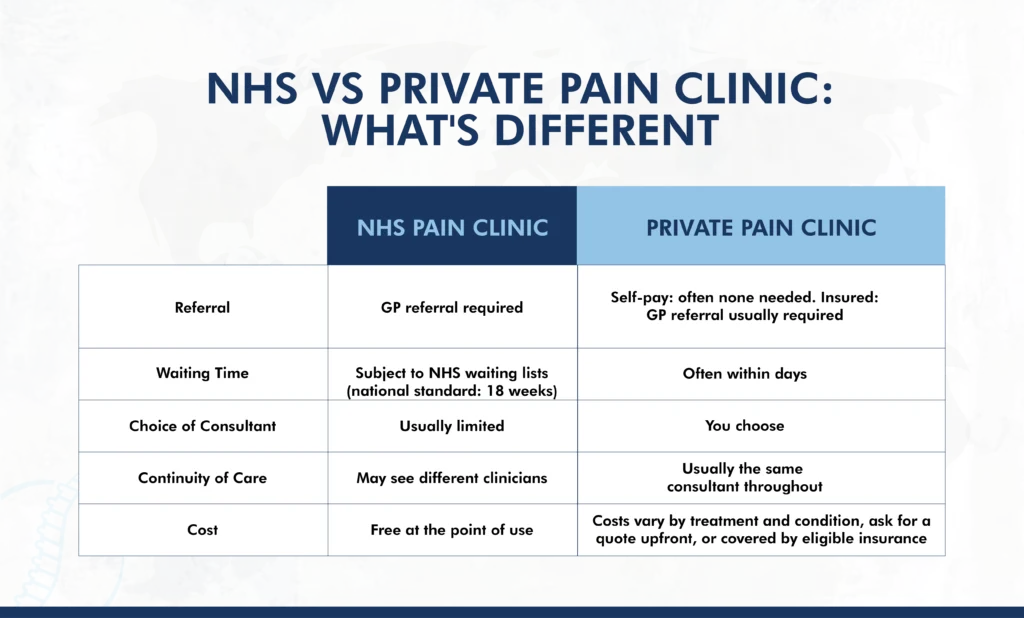
The main differences are waiting time, referral requirements, and who you see and how consistently. NHS pain clinics are free at the point of use but require a GP referral and can involve a long wait. Private clinics often see self-paying patients without one and typically offer an appointment within days, with the same consultant throughout.
How the NHS Pathway Works
NHS care needs a GP referral. Under the NHS Constitution for England, patients have the right to start consultant-led treatment within 18 weeks of referral for most conditions. Nationally, that standard hasn’t been met since 2016: NHS England’s most recent figures, published July 2026, put the waiting list at 7.28 million cases for May 2026, with a median wait of 12.4 weeks against the 18-week standard.
How Private Pain Clinic Care Works
Paying for yourself, you can often book directly, without a referral, though self-pay guidance from major hospital groups notes that diagnostic scans still usually need one. Using private medical insurance, your insurer will usually still require a GP referral and pre-authorisation before it covers the claim. A private consultant assesses you, carries out any procedure, and reviews your progress, so you’re not re-explaining your history to someone new each time.
Which Option Suits Your Needs
Going private mainly changes how quickly you’re seen and who you see, not which guidelines your consultant follows. If the NHS pathway is already moving for you, there’s often no need to change route.
What Happens During Your First Pain Clinic Appointment?
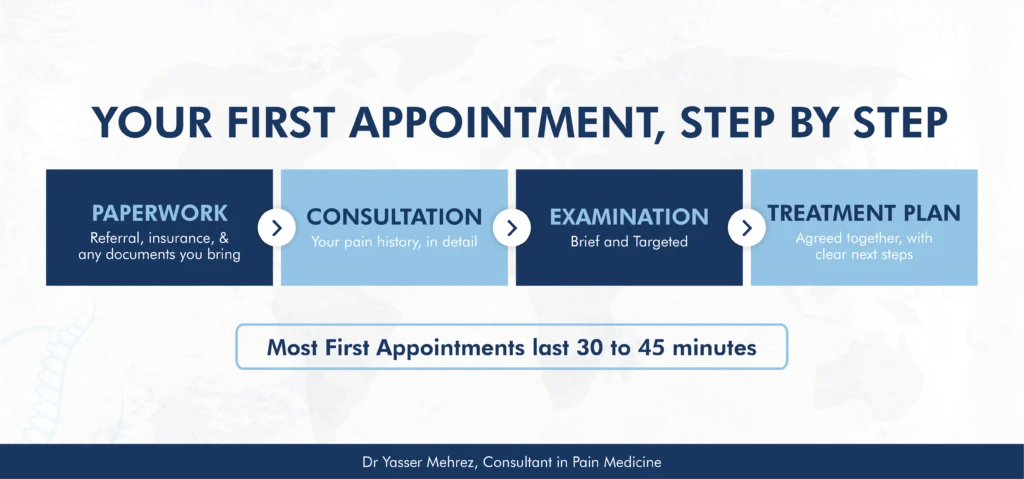
Your first appointment has four parts: paperwork, a conversation about your pain, a short examination, and a plan you agree together. Most of the visit is talking rather than examining, and a procedure on the same day is rare.
Review of Your Pain History
Usually the longest part of the visit. Your consultant will ask where the pain is, whether it spreads, when it started, and how it affects your sleep, mood, and work. You’ll also cover every treatment you’ve tried, and it helps to be specific: “gabapentin didn’t help” tells a consultant less than “I stopped it after four days at 300mg because it made me drowsy.” Dose, side effects, and duration all shape what happens next.
This kind of review is called a biopsychosocial assessment, covering the physical, psychological, and social sides of pain together. It does not mean your pain is being treated as imaginary. Pain genuinely changes with stress, sleep, and activity, so understanding those factors helps your consultant reach an accurate diagnosis.
Discussion of Scans, Tests, and Medicines
Most people expect an MRI or X-ray straight away. NICE guideline NG59 advises against routinely offering imaging for low back pain outside a specialist setting, because scan findings don’t reliably explain pain: disc bulges and age-related wear show up in people with no symptoms at all.
A diagnostic nerve block is often more useful. Your consultant injects local anaesthetic next to a suspected nerve under X-ray guidance. If your pain eases, even briefly, that nerve is likely carrying it; if nothing changes, the source lies elsewhere. Either result is information, which is why this counts as a test, not a treatment.
Physical Examination
The exam is brief and targeted rather than head to toe. Your consultant checks movement, strength, sensation, and reflexes, then examines whatever reproduces your symptoms. The aim is to find what the pain is coming from, not just where it hurts.
Your First Treatment Plan
Before you leave, you should understand the likely cause of your pain, your options, and what happens next. One question shapes this more than any other: is the pain itself the condition, with no other cause found, or is it caused by something identifiable, such as arthritis or a damaged nerve? NICE calls these chronic primary pain and chronic secondary pain, and guideline NG193 treats them differently.
Side Effects and Risks
Both spinal blocks and epidurals are generally safe, but they carry potential side effects and rare serious risks. Understanding these helps you make informed decisions. Below are key risks and red flags that require urgent medical attention:
Will You Receive Treatment on Your First Visit?
Usually not. Your first appointment is an assessment, not a procedure. If treatment is needed, most consultants arrange it as a separate visit, with time set aside for consent, image guidance, and recovery.
When Treatment Starts on the Same Day
Some things can start immediately: a medication change, a referral for physiotherapy, or a written pain management plan. A procedure, such as an injection, needs its own consent process and often sedation, which is why it’s normally booked as a separate visit rather than added on the same day.
When Further Tests Are Needed
If your diagnosis isn’t clear from the history and examination alone, your consultant may arrange a diagnostic nerve block or, less often, imaging, before deciding on treatment. That adds a step, but it means the treatment you’re eventually offered actually matches the cause.
Common Treatment Options at a Pain Clinic
Medication review. For chronic primary pain, NICE guideline NG193 advises against starting most pain medicines. That includes opioids, everyday painkillers such as paracetamol and anti-inflammatories, and nerve pain drugs such as gabapentin and pregabalin, since the evidence doesn’t show they help long term. NICE recommends a low-dose antidepressant instead, such as amitriptyline, duloxetine, or sertraline, used for pain rather than mood. The Faculty of Pain Medicine’s Opioids Aware resource explains why long-term opioids often do more harm than good here.
Injections. Depending on your diagnosis, this might mean an injection into a spinal joint (a medial branch block), next to a single nerve, or into the space around the spinal nerves (an epidural). All are guided by live X-ray or ultrasound. NG59 advises against spinal injections for non-specific low back pain, and reserves an epidural for acute, severe sciatica rather than leg pain from a narrowed spinal canal.
Radiofrequency ablation. RFA uses heat to interrupt pain signals in the small nerves supplying the spinal joints, usually after a test injection confirms those nerves are the source and other treatment hasn’t worked.
Physiotherapy, programmes, and psychological support. NICE recommends supervised exercise for chronic primary pain. A pain management programme goes further: physiotherapy, education about how pain works, and pacing, usually in a group over several weeks. The aim is reducing how much pain limits you, rather than removing it entirely. Long-term pain wears down sleep and mood, which then makes pain feel worse, so breaking that cycle through CBT counts as a genuine part of the plan, not an add-on.
For severe nerve pain that hasn’t responded to other treatment, spinal cord stimulation may be an option, trialled temporarily first so you can judge the benefit before anything permanent is fitted.
How to Prepare for Your Pain Clinic Appointment
A little preparation makes the appointment more useful: what to bring, what to note beforehand, and what’s worth asking while you’re there.
What Documents to Bring
Bring a list of your current medications and doses, your GP referral letter or medical summary, and copies of any recent scans or test results. Add your insurance details and pre-authorisation code if it applies. This saves repeating what your GP already holds and gives your consultant a clearer starting picture.
What Symptoms to Note
Note when the pain started, what makes it better or worse, how it affects your sleep, mood, work, and daily activities, and exactly what you’ve already tried, including doses and how long. Specific notes beat a general description on the day.
Questions to Ask the Specialist
Worth asking: what’s likely causing the pain, the treatment options and their risks, whether imaging or a diagnostic block is needed first, and what your GP will be told afterwards. If a procedure is recommended, ask for a written quote covering the consultation, procedure, hospital and sedation fees, and whether follow-up is included.
Why Choose Dr Yasser Mehrez?
You shouldn’t have to take a website’s word for it, so here’s what you can actually check yourself.
Every Procedure, the Same Consultant
Dr Yasser Mehrez has practised as a Consultant in Pain Medicine and Anaesthesia since February 2007, and is Lead Clinician for Pain Management Services at Milton Keynes University Hospital NHS Foundation Trust. Every private appointment is with him directly, from the first consultation through any procedure and follow-up.
Qualified, Verified, and On Record
He trained at the South Thames School, London Deanery, including a year at the Guy’s and St Thomas’ Hospital Pain Management Centre, where spinal cord stimulation remains a particular interest. He’s a member of the British Pain Society and a Fellow of the Faculty of Pain Medicine. You can check any doctor’s registration, including his, on the GMC’s public register, and read independent patient reviews on his TopDoctors profile. He’s also recorded his own patient-education video answering this exact question on AnswerCast.
Seen Within Days, Not Months
Dr Mehrez sees patients at his practice in 107 Harley Street, London W1G 6AL, and at hospitals including The Saxon Clinic in Milton Keynes and Three Shires Hospital in Northampton. Appointments are usually available within days, and he’s recognised by insurers including Bupa and AXA Health.
Frequently Asked Questions
Do I need a GP referral to see a pain specialist privately?
Using insurance, yes, to authorise the claim. Paying for yourself, often not, though this varies by consultant, so check when you book.
Will I be given an injection at my first appointment?
Usually not. Your first visit is an assessment. Any procedure needs image guidance and separate consent, and radiofrequency treatment specifically requires a diagnostic block first.
Do pain clinics prescribe strong painkillers?
Often the opposite. NICE advises against starting most pain medicines for chronic primary pain. A pain clinic is more likely to review and reduce your current medication than add to it.
What conditions can a pain clinic treat?
Most types of persistent pain, including back and neck pain, sciatica, arthritis, neuropathic pain, CRPS, fibromyalgia, and pelvic or cancer pain. What matters is that the pain has lasted and is affecting your life, not the specific diagnosis.
Is a pain clinic the same as being told my pain is "in my head"?
No. A pain clinic uses a biopsychosocial assessment, looking at physical, psychological, and social factors together, because all three genuinely affect how pain is experienced. This is a recognised clinical approach, not a way of dismissing real physical pain.
Is it worth going private for pain management?
Depends on your situation more than any general answer can cover. If the NHS route is working for you, there’s often no need to change; if you’re waiting and getting worse, earlier assessment has genuine value.
Book a Consultation
If your pain has lasted more than three months and nothing so far has properly explained it, that’s usually reason enough to see a specialist rather than keep waiting. Book a consultation with Dr Mehrez.