

Complex regional pain syndrome is a long-lasting pain condition that usually affects one arm, leg, hand or foot after an injury, fracture or operation. It can cause burning or electric pain, swelling, colour or temperature changes, stiffness and extreme sensitivity to touch. A pain specialist can assess the pattern, rule out other causes and explain the next treatment options.
Dr Yasser Mehrez has worked as a Consultant in Pain Medicine and Anaesthesia since 2007. He is a Fellow of the Faculty of Pain Medicine and is registered with the General Medical Council under GMC number 5171889. Public consultant profiles list his qualifications and several hospital affiliations.
In short
- CRPS usually affects one arm, leg, hand or foot.
- It often follows a fracture, sprain, crush injury, operation or other injury.
- Pain may feel burning, electric, throbbing, aching or unusually severe.
- The affected limb may swell, change colour or temperature, become stiff or become sensitive to touch.
- There is no single scan or blood test that confirms CRPS.
- Treatment usually combines movement-based rehabilitation, medication review, education and support.
- Early assessment can help address stiffness, reduced movement and loss of function.
Consultant in Pain Medicine and Anaesthesia since 2007 · Fellow of the Faculty of Pain Medicine · GMC No. 5171889 · 107 Harley Street, London W1G 6AL · 01908 014486
What Is Complex Regional Pain Syndrome?
CRPS is a pain condition in which the nervous system continues to produce pain and other changes after an injury. Symptoms may continue after the original tissue injury would normally be expected to improve.
The pain can feel burning, electric, throbbing, aching or stabbing. In addition, the limb may also become swollen, unusually hot or cold, change colour, sweat differently or become difficult to move.
CRPS is a recognised physical condition. It is not imaginary and is not caused by a patient failing to cope. The condition sits within the wider group of chronic and neuropathic pain conditions. Doctors may also describe CRPS as a post-traumatic pain condition because it often follows an injury.
Some symptoms are associated with changes in the autonomic nervous system. This system helps regulate blood flow, sweating and temperature. These changes may help explain why one limb looks or feels different from the other.
For more information about related conditions, see our guide to chronic pain treatment.

What are the Symptoms of CRPS?
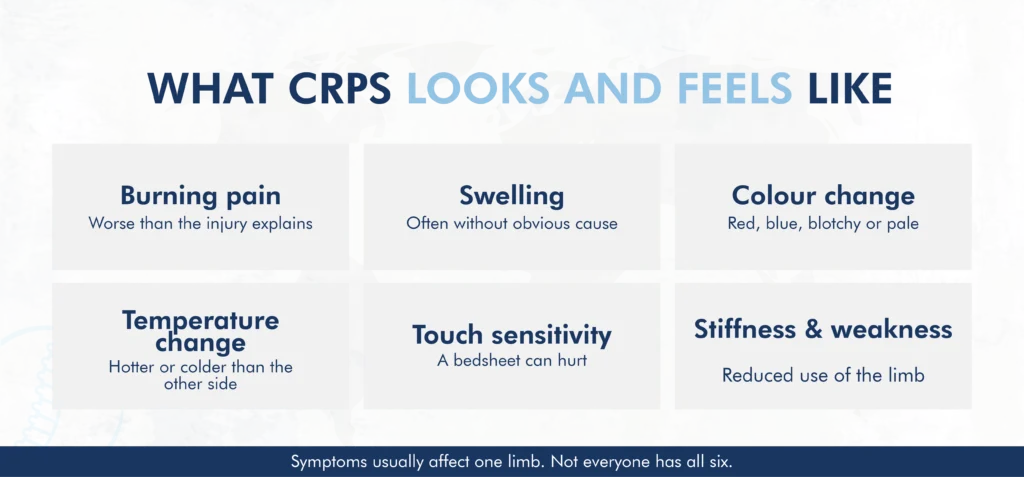
CRPS symptoms may affect pain, sensation, swelling, skin colour, temperature, sweating and movement. Not every patient has every symptom, and symptoms can change over time.
Burning pain and Pain out of Proportion
Burning pain is a common description of CRPS, although some people experience electric, throbbing, aching or stabbing pain. The pain may continue or become more severe than would normally be expected from the original injury.
However, clinicians do not assess CRPS by pain intensity alone. They consider how the pain developed, whether the limb has changed and whether another condition could better explain the symptoms.
Pain after a fracture, sprain or operation does not automatically mean that a person has CRPS. An assessment is needed to understand the overall pattern.
Swelling, Skin Colour Change and Temperature Change
The affected limb may swell. In some cases, clinicians may describe this as oedema. The skin can become red, blue, blotchy, pale or unusually shiny.
The limb may also feel warmer or colder than the opposite side. Some people notice changes in sweating, hair growth, nail growth or skin texture.
These features can form part of the CRPS pattern, but they do not confirm the diagnosis on their own. Cambridge University Hospitals explains additional CRPS symptoms.
Touch Sensitivity and Movement Pain
Allodynia means pain from something that would not normally hurt. A bedsheet, sleeve or light touch may cause severe pain.
Hyperalgesia means an unusually strong response to something that would normally be painful. Mild pressure or a small knock may feel much more painful than expected.
As a result, movement may also cause pain. This can lead people to protect the limb or avoid using it, which may contribute to stiffness and reduced function.
Stiffness, Weakness and Reduced Use
Pain can make a person use the limb less. Reduced use may then lead to stiffness, weakness, reduced confidence and difficulty with everyday movements.
A person may avoid walking, gripping, reaching, typing or carrying objects. Rehabilitation aims to rebuild movement safely and gradually rather than forcing the limb through severe pain.
What Causes CRPS?
CRPS usually begins after an injury to a limb, most often a fracture, sprain, crush injury or operation. However, the cause is not fully understood, but it is thought to involve a prolonged, abnormal response of the nervous and immune systems to that injury.
Can CRPS Start After Injury, Fracture, Sprain or Surgery?
Why Does It Start in Some People and Not Others?
At present, this is not yet known. Current thinking is that pain signalling between limb and brain stays switched on after the tissue heals. It is not caused by anything the patient did.
Can CRPS Start with No Clear Trigger?
Yes. In fact, in a a minority of cases no injury or operation is ever identified. The absence of a trigger does not rule out CRPS, and it makes the pain no less real and no less treatable.
CRPS Type 1 vs Type 2
CRPS type 1 is diagnosed when no confirmed injury to a specific nerve has been identified. By contrast, type 2 is diagnosed when a specific nerve injury is present. However, the symptoms and many treatment principles can be similar.
What Is CRPS Type 1?
Type 1 is the more common form, following an injury such as a fracture or sprain where no major nerve was damaged. It is defined by the absence of confirmed nerve damage.
What Is CRPS Type 2?
Type 2 is diagnosed when injury to a specific nerve is confirmed, for instance after a laceration or surgical injury. The nerve damage explains part of the picture but not the disproportionate pain, swelling and colour change.
Why Does the Difference Between Type 1 and Type 2 Matter?
Mainly for clarity and medico-legal reporting, since treatment is similar. Two further categories exist: CRPS-NOS, and one for people who once met the criteria but have since lost limb signs.
How Is CRPS Diagnosed?
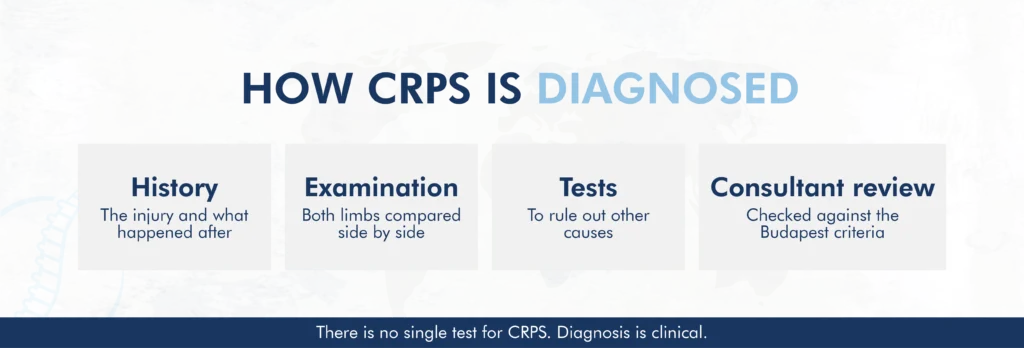
CRPS diagnosis is clinical. Importantly, no blood test or scan confirms it. UK practice follows the Budapest criteria, set out in the Royal College of Physicians guidelines. These require disproportionate pain plus a combination of reported symptoms and observed signs, with no better explanation.
Diagnosis follows four steps:
- History: The original injury, how the pain behaved afterwards, and what the limb has done since are reviewed.
- Examination: Both limbs are compared for swelling, colour, temperature, sweating, movement and response to touch.
- Tests to exclude other causes: Imaging or blood tests may be used where another condition needs to be ruled out.
- Consultant review: The findings are checked against the Budapest categories to confirm or exclude the diagnosis.
History and Symptom Pattern
The history is an important part of CRPS assessment. The consultant may ask about:
- The original injury, fracture, operation or other event.
- When the pain began and how it changed.
- Changes in swelling, colour, temperature or sweating.
- Sensitivity to touch and movement.
- Changes in sleep, work, walking, grip or daily activities.
- Treatments, medicines and therapies already tried.
A written timeline can help show how symptoms developed. Photographs of the limb during a severe flare may also be useful because visible changes are not always present on the day of examination.
Physical Examination
Both limbs are usually compared side by side. The consultant may assess:
- Swelling.
- Skin colour.
- Temperature.
- Sweating.
- Hair and nail changes.
- Range of movement.
- Strength and function.
- Response to light touch or pressure.
CRPS is assessed by looking at the overall pattern and differences between the affected and unaffected sides.
Tests and Scans to Rule Out Other Causes
Tests do not confirm CRPS. Instead, they may be used when another condition needs to be ruled out.
Depending on the history, a clinician may consider an X-ray, MRI scan, ultrasound, nerve conduction study or blood tests. These may help assess conditions such as infection, a non-healing fracture, inflammatory arthritis, a blood clot, nerve compression or another cause of pain.
For related symptoms involving nerve compression or sciatica, see our guide to a Sciatica Pain in Groin. A fibromyalgia treatment assessment may also be relevant when widespread pain is being considered.
What a Consultant Looks For
The Budapest criteria assess continuing pain that is disproportionate to the original injury, together with symptoms reported by the patient and signs found during examination.
The criteria group symptoms and signs into four categories:
- Sensory: increased sensitivity or pain from touch.
- Vasomotor: changes in skin colour or temperature.
- Sudomotor or oedema: sweating changes or swelling.
- Motor or trophic: reduced movement, weakness or changes in hair, nails or skin.
The consultant also considers whether another diagnosis provides a better explanation.
What Treatments Help CRPS?
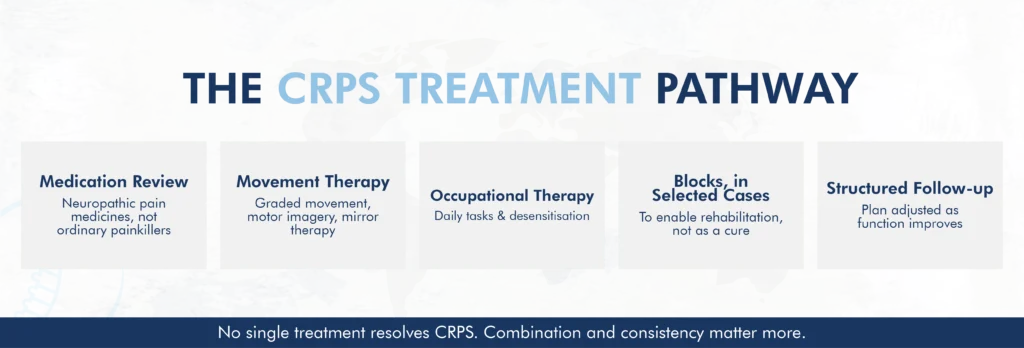
CRPS treatment in the UK is built around restoring movement and function, supported by medication review and psychological input, delivered by a multidisciplinary team. There is no cure and no single procedure resolves it. The best results come from combining approaches early.
How Does a Medication Review Help?
The NHS lists anticonvulsants or antidepressants among the main approaches, alongside education and self-management. These target neuropathic pain rather than inflammation, so ordinary painkillers often disappoint.
How Do Physiotherapy and Graded Movement Help?
Physiotherapy is the backbone of treatment, not an add-on. Graded movement rebuilds use of the limb in steps small enough to avoid a flare, while graded motor imagery and mirror therapy retrain how the brain maps it.
What Does Occupational Therapy Do?
Occupational therapy focuses on the tasks that matter to you: dressing, driving, typing, returning to work. Therapists also use desensitisation, reintroducing touch through different textures and temperatures to make allodynia less disabling.
Why Is Psychological Support Part of CRPS Treatment?
Because persistent pain changes sleep, mood and confidence, and those changes feed back into the pain. The NHS includes psychological support such as CBT among the main treatments. This does not treat the pain as psychological.
Do Sympathetic Blocks Work for CRPS?
Sometimes, in selected patients, and the evidence is weaker than many clinic websites suggest. A Cochrane review of sympathetic block found no evidence it outperformed placebo, and insufficient high-quality evidence to support or refute its use.
In practice it is used mainly to identify the subgroup whose pain responds to sympathetic blockade, and to reduce pain enough for physiotherapy to progress. Any clinic offering it as a stand-alone cure is overstating the case.
What Is a Pain Management Programme?
A pain management programme is a structured course combining physical rehabilitation, pacing, psychological techniques and education. It targets function and quality of life rather than elimination of pain and often suits long-standing CRPS.
When Are Image-Guided Injections Suitable?
Where a separate, identifiable pain source contributes alongside CRPS, treatments such as epidural infiltration, radiofrequency treatment or fluoroscopic-guided injections may form part of a wider plan. These treatments are not treatments for CRPS itself.
Discuss pain management for CRPS
Treatment options depend on the assessment. Ask for the current consultation fee, treatment setting and follow-up arrangements before booking.
Does Early Treatment Matter?
Yes, and it is the most useful thing to know. Assessment and rehabilitation started soon after symptoms appear are widely considered to improve the chance of recovery, while long delays allow stiffness, disuse and loss of function to become established.
The reasoning is practical as well as clinical. The longer a limb goes unused, the more strength and movement are lost, and the harder rehabilitation becomes.
There is evidence behind it. A prospective study following 59 patients through their first year found that improvement was greatest in the first six months. It then plateaued. The authors concluded that early intervention is worth exploring to prevent long-term disability. This was not a randomised trial. However, it provides evidence beyond clinical opinion.
What Happens at a Pain Clinic Appointment for CRPS?
A first appointment at a pain clinic for CRPS is mostly conversation and examination. You give a detailed history, both limbs are examined and compared, function is assessed, and you leave with a working diagnosis and an agreed plan. No procedure happens at the first visit.
What Do You Need Before You Arrive?
Self-referral is usually accepted for self-pay patients, while insured patients normally need a GP referral for the claim to be authorised. Bring this checklist:
- Referral letter, if you have one
- All current medicines, with doses, and anything already tried
- Imaging reports, fracture clinic letters or operation notes
- A written timeline of the injury and how symptoms developed
- Photographs of the limb when colour or swelling was worst
- Insurer name, policy number and pre-authorisation code, if insured
What Happens During the Consultation and Assessment?
Expect a long conversation. Your consultant takes the history of the injury, the pain and the limb, then asks how symptoms affect sleep, work and daily life.
What Does the Physical Examination and Function Review Involve?
Both limbs are examined side by side for swelling, colour, temperature, sweating, movement and touch response. Function is assessed practically: grip, weight-bearing, reach and the movements you avoid.
How Is Your Treatment Plan Agreed?
You and your consultant agree what happens next and in what order: a medication decision, a therapy referral, structured follow-up, and a letter to your GP.
NHS Pain Treatment vs Private CRPS Treatment
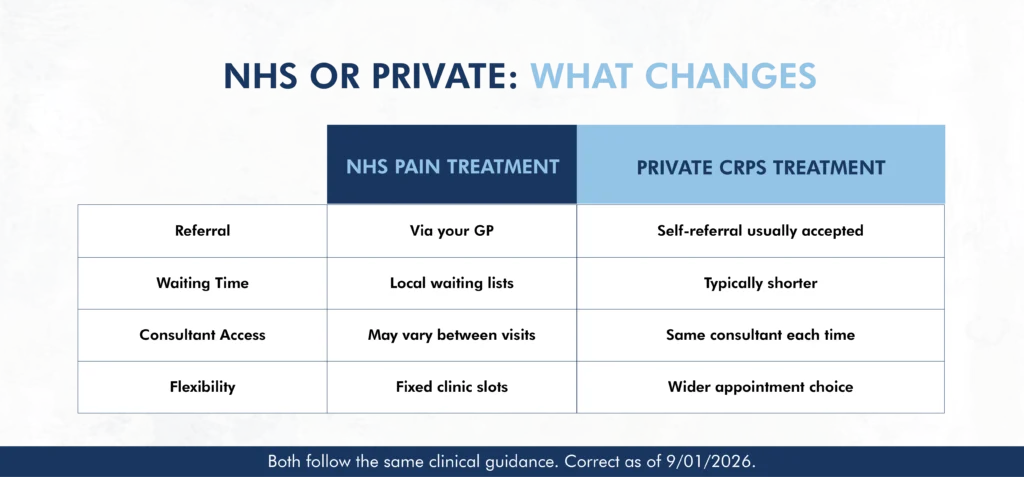
NHS and private CRPS care follow the same clinical guidance and diagnostic criteria. However, the medicine does not change. What differs is how quickly you are seen and whether you see the same consultant at each visit.
| NHS pain treatment | Private CRPS treatment | |
|---|---|---|
| Referral | GP referral required | Self-referral usually accepted for self-pay; GP referral needed for insurance |
| Waiting time | Subject to local waiting lists | Typically, shorter (client to verify) |
| Consultant access | May see different clinicians across visits | Same consultant at every appointment |
| Multidisciplinary team | Established pain services with physiotherapy and psychology | Coordinated by your consultant across independent providers |
| Appointment flexibility | Fixed clinic slots | Wider choice where available (client to verify) |
| Cost | Free at the point of use | Self-pay or via insurance, subject to policy terms |
How Do Referral Routes and Waiting Times Compare?
The NHS route runs through your GP into a local pain service, and waiting times vary by area. By comparison, self-pay patients usually book directly, while insured patients may need a GP referral and insurer pre-authorisation. Bupa requires pre-authorisation for covered benefits and treatment with a recognised practitioner. Coverage depends on the policy, and ongoing management of a chronic condition such as CRPS may be excluded.
How Does Consultant Access and Continuity of Care Differ?
Privately, the consultant who assesses you is the consultant who reviews you. For a condition judged by how a limb changes over months, that continuity matters.
How Much Faster and More Flexible Are Private Appointments?
Usually faster, though the honest answer depends on current clinic capacity rather than any general claim. Appointments outside working hours are more often available privately.
Independent hospitals in England are registered and inspected by the Care Quality Commission, with inspection reports published at cqc.org.uk.
How to Live Day to Day With CRPS
Living with CRPS is mostly about pacing, protecting sleep, and keeping the limb in use within limits you set deliberately rather than limits pain sets for you. Instead, small, consistent activity beats bursts of effort followed by days of recovery, and a written flare plan beats improvising.
What Is Pacing and Activity Planning?
Pacing means deciding in advance how much of an activity you will do, and stopping there, including on good days. Boom and bust undoes progress.
How Do You Manage Sleep, Stress and Flares?
Poor sleep lowers pain tolerance, and higher pain worsens sleep. A consistent bedtime and a wind-down routine both help. Agree a written flare plan with your consultant in advance.
How Do You Manage Work, Home Tasks and Support?
Talk to your employer early about reasonable adjustments: altered hours, equipment or task changes. Tell those around you what allodynia means, so a hand on the arm is not a surprise.
When to Seek Urgent Medical Help
Contact your GP, NHS 111 or A&E rather than waiting for a clinic appointment if symptoms change suddenly, if there are signs of infection, or if new weakness appears. CRPS symptoms fluctuate, however, rapid change needs same-day assessment to exclude another cause.
What Sudden Swelling, Colour Change or New Weakness Needs Checking?
Seek same-day advice for a limb that becomes suddenly and severely swollen, turns markedly pale, blue or mottled, or develops new weakness. These can indicate a clot or a circulation problem.
When Do Fever or Wound Concerns Matter?
Any fever, spreading redness, heat or discharge from a wound or surgical site needs same-day assessment. Infection can mimic a CRPS flare and will not respond to CRPS treatment.
What Counts as Symptoms Changing Too Fast?
A flare usually builds over hours or days in a familiar pattern. Sudden change over minutes, symptoms in a limb never affected, or unexplained loss of function warrant urgent review.
Frequently Asked Questions
What is the first sign of CRPS?
Usually pain worse and longer lasting than the original injury explains, often burning in character. Swelling, colour change or sensitivity to light touch in the same limb typically follow.
Is CRPS type 1 the same as type 2?
No, but the difference is narrow. Type 1 is diagnosed where no confirmed nerve injury is found, type 2 where a specific nerve injury is present. Treatment is broadly the same.
How is CRPS diagnosed?
Clinically, using the Budapest criteria, with no single confirmatory test. Because signs come and go, not everyone meets every category on the day they are examined, and a diagnosis of CRPS-NOS may apply instead.
What Treatments Help CRPS Pain?
Physiotherapy and graded movement, occupational therapy, a neuropathic pain medication review, and psychological support, usually combined. Sympathetic blocks are used in selected cases, mainly to enable rehabilitation.
Is CRPS permanent?
Published recovery rates vary enormously with how recovery is defined. The NHS reports that around 85% of people with CRPS experience reduced pain and some symptom improvement within two years. A population-based records review found 74% resolved, usually spontaneously; a prospective study found 5.4% symptom-free at 12 months. Importantly, these figures measure different outcomes, not contradictory ones; the NHS states there is no cure, but treatment helps manage symptoms.
Does CRPS Spread to Another Limb?
Usually it affects one limb only, though it can sometimes spread to other parts of the body. New symptoms elsewhere should be assessed, not assumed to be CRPS.
What Specialist Treats CRPS?
A consultant in pain medicine, working with physiotherapy, occupational therapy and psychology. Look for Fellowship of the Faculty of Pain Medicine (FFPMRCA) and current GMC registration, both checkable on the public registers. NHS England also commissions a national CRPS service in Bath taking UK-wide referrals for complex cases.
Is Self-Referral Possible to a Private Pain Clinic in London?
Yes, for self-pay patients, in most cases. If claiming on private medical insurance, your insurer will normally require a GP referral before authorising treatment, so contact them first.
What Should I Bring to my First Appointment?
Your referral letter, all current medicines, imaging reports or operation notes, a written timeline of symptoms, photographs of the limb at its worst, and insurance details.
Does Early Treatment Matter for CRPS?
It is widely considered to. Earlier assessment means rehabilitation begins before stiffness and disuse become entrenched, though the evidence rests more on clinical experience than large trials.
If your pain is worse than your injury explains, and the limb has changed colour, temperature or size, have it assessed rather than waiting. Complex regional pain syndrome treatment in London is available privately without a GP referral for self-pay patients. CRPS Network UK publish patient resources.