



The worry with private pain treatment usually isn’t the first invoice. It’s not knowing whether a second, third, or open-ended one is coming after it.
Private pain treatment has no single fixed price. The total depends on your consultation, any scans, the procedure, and your follow-ups. If your policy covers pain medicine, insurance may pay part of it. If you’re self-pay, get the full fee path in writing before you book.
Dr Yasser Mehrez is a consultant in pain medicine and anaesthesia (FRCA, FFPMRCA, MSc). He has 19+ years’ experience treating back pain, sciatica, and chronic pain. Based at 107 Harley Street, he treats back pain and chronic pain through Circle Health Group and HCA Healthcare. He also holds an NHS post at Milton Keynes University Hospital.
Request a Written Quote
Consultant-led, from first visit to follow-up. GMC No. 5171889. Clinics in Harley Street, Milton Keynes, Northampton, and Harpenden.
When to Get Help Immediately
Cost should never delay urgent care. Call 999 or go to A&E immediately if you have any of these symptoms:
- New numbness around your back passage, genitals, or inner thighs.
- Sudden loss of bladder or bowel control.
- New weakness in both legs.
- Back pain with a high fever.
- Severe or progressive back pain, especially with a history of cancer or unexplained weight loss.
The first three can signal cauda equina syndrome, a surgical emergency. Fever or cancer history with worsening back pain also needs same-day assessment. This rules out infection or a more serious cause. Don’t book a private clinic for any of these signs.
In Short
- Variable pricing: Private pain treatment price depends on the consultation, scans, procedures and follow-up care.
- Insurance cover: Insurance often covers part of the pathway when the policy includes pain medicine.
- Self-pay structure: Self-pay patients pay per step, so ask for the full fee path before booking.
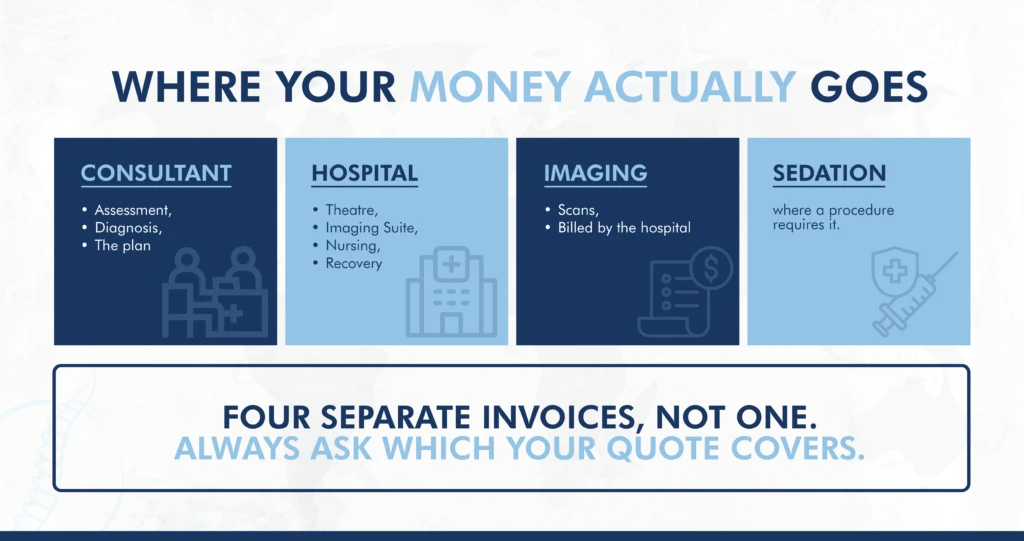
- Multiple invoices: You’ll normally get separate invoices from the consultant, hospital, imaging team, and anaesthetist.
- Fee transparency: Every consultant’s fees are published on the PHIN register, free to check.

How Much Does Private Pain Treatment Cost in the UK?
There’s no single figure, because private pain care is billed per step, not as one package. Cost depends on how many of those steps your diagnosis needs. PHIN explains that consultant fees typically cover the consultation, procedure, and follow-up. Hospital and anaesthetist charges are separate.
That point matters more than any price list. You’re not buying a course of treatment upfront. You’re buying an assessment, then you get a plan and a quote, and you decide from there.
| Step | What It Covers | Fee |
|---|---|---|
| Initial consultation | Assessment, examination, diagnosis and a written plan | Site-specific fee |
| Follow-up consultation | Review of progress, medication changes, next steps | Itemised upon treatment plan agreement |
| Imaging (MRI, CT, ultrasound, X-ray) | Billed by the hospital, not the consultant | Hospital-billed separately per imaging protocol |
| Diagnostic nerve block | A test injection to confirm the pain source | Itemised professional and facility fee |
| Private epidural injection | Image-guided injection into the epidural space | Itemised professional and facility fee |
| Radiofrequency ablation | Usually follows a diagnostic block | Itemised professional and facility fee |
| Hospital or facility fee | Theatre, imaging suite, nursing time, recovery | Billed separately by the hospital |
| Sedation or anaesthetist fee | Where sedation is used for a procedure | Billed separately where applicable |
What Is Included in the Price?
A single quoted price for an injection is usually only part of the total. PHIN explains that consultant fees exclude hospital and anaesthetist costs, unless there’s a package price. For genuine treatment and consultation fees, there’s usually no VAT on top. Medical treatment by a registered health professional is VAT-exempt under HMRC’s VAT Notice 701/57.
Some clinics sell pain management packages that bundle these together. Always ask directly whether your quote is an inclusive package or an itemised summary.
What Does the Consultation Fee Include?
The consultation fee covers your consultant’s time: your pain history, an examination, a working diagnosis, and a written plan. For chronic pain, most of that appointment is conversation rather than examination.
It also covers the letter sent to your GP. It doesn’t cover a scan, injection, or medication arising from the visit.
Are Scans and Tests Charged Separately?
Yes, and they’re not automatic. Imaging is billed by the hospital, not your consultant. NICE guideline NG59 advises against routine imaging for low back pain outside a specialist setting. Scan findings often don’t explain the pain.
Disc bulges and age-related wear show up in people with no symptoms at all. A diagnostic nerve block is often more useful. If you’re self-pay, scan rules can still vary by provider, so confirm referral requirements before you book.
What Do Procedures Cost?
A procedure is quoted as a professional fee. The theatre or imaging suite, nursing time, and recovery are hospital charges, and sedation is a further fee. Image-guided pain injections include facet joint injections, medial branch blocks, nerve root blocks, and epidurals.
Dr Mehrez’s Spire profile lists neuropathic pain among his clinical interests. He also offers facet joint injections and ultrasound-guided radiofrequency treatment (RFA) for longer-lasting relief. Fees also differ by site, so where your treatment happens can change what it costs.
Is Follow-Up Care Included?
Follow-up consultations are usually billed separately, based on your recovery plan. Most treatment plans include at least one review. Injections in particular get assessed for how long the relief lasted.
Private Health Insurance vs Self-Pay
Disclaimer: This section gives general information about how private pain treatment costs are structured and how insurance policies typically work. It’s not personalised financial, insurance, or medical advice. Confirm the details of your own policy, including excess, pre-authorisation, outpatient limits, and exclusions, directly with your insurer or broker.
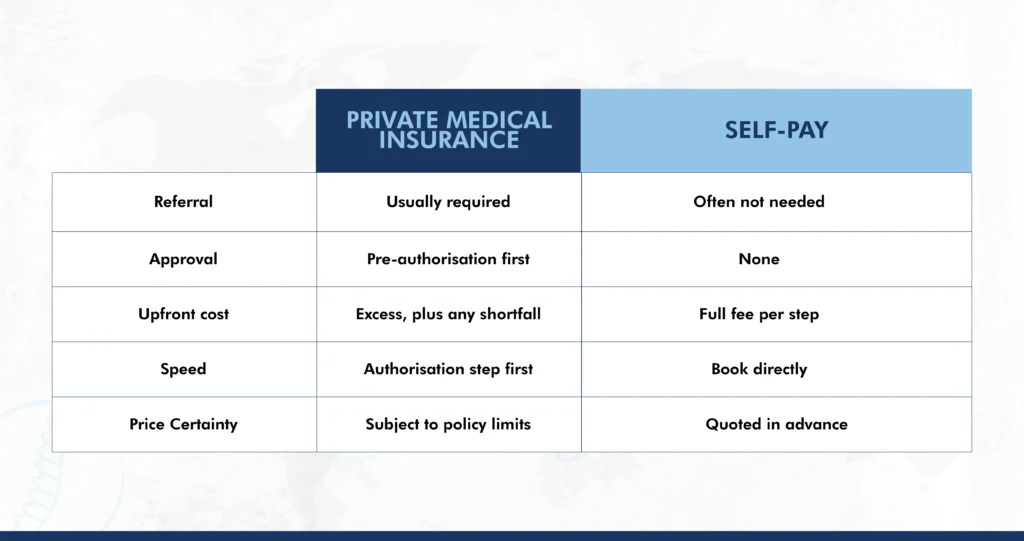
Insurance usually covers more of the pathway, but adds administrative steps and a shortfall risk. Self-pay costs more upfront, and gives you a fixed, visible price with no policy conditions attached. Which suits you depends less on your income than on what your policy excludes.
How Does Private Health Insurance Work?
Your GP refers you, your insurer authorises treatment, and the consultant and hospital bill the insurer directly. PHIN notes that fee arrangements vary by consultant, hospital, and insurer, and this fee information is visible on consultant profiles.
Insurers generally cover pain treatment when it’s classed as acute, responding quickly and returning you to your usual health. Chronic pain needs ongoing management, with no expected cure. It’s usually not covered once diagnosed as chronic, even with no pre-existing-condition issue at all. Insurer wording varies here, so check your own policy rather than assuming.
Bupa’s own guidance says pre-existing conditions are usually not covered. Chronic conditions are often excluded, or treated differently, depending on the policy. Other major insurers take a similar approach: ongoing monitoring or indefinite care needs are typically excluded from standard cover.
What Are Pre-Authorisation and Excess?
Pre-authorisation is your insurer’s written approval before treatment starts. Excess is the amount you pay before cover begins. Call your insurer before you book, not after.
Excess is usually payable once per policy year, not once per claim. If you’ve already claimed this year, you may owe nothing further. Where a consultant is recognised but not fee-assured, a gap can open up. The gap between the fee and what your insurer pays falls to you.
The pre-existing-condition exclusion above is driven by underwriting. With moratorium underwriting, pre-existing conditions are excluded until you’ve had a clear symptom-free period. This is often around two years, though the exact length varies by insurer. With full medical underwriting, exclusions are stated upfront and can be harder to lift later.
Day-case procedures, which is what most pain injections are, usually fall under the same, more generous cover as inpatient treatment. Outpatient cover, meaning consultations and scans, is what’s typically capped. So your consultation might eat into a capped benefit while the injection itself doesn’t, although this varies by plan.
When Does Self-Pay Suit You?
Self-pay can be more straightforward than a claim in a few situations. A pre-existing or chronic exclusion, a reached outpatient limit, an excess close to the fee, or no claim on record. Insurance exclusions are one of the most common reasons patients fund treatment themselves.
Not sure what your policy covers? Check with your insurer directly before booking.
Consultant since 2007 | Recognised by Bupa and WPA, fee-assured | Fee transparency on every quote.
What Changes the Final Price?
Four things move the total, and only one is your diagnosis. The others are whether imaging is genuinely needed, which procedure is chosen, and how long you stay under review. Knowing these four is how you predict cost before you commit.
How Does Condition Complexity Change the Price?
Pain from one spinal level costs less to investigate than widespread pain with no clear source. More body areas mean more injections, and more injections mean a higher total.
Back pain or sciatica traced to one or two facet joints may need a single diagnostic block. Several areas involved means more injections, more theatre time, and a higher total. Conditions such as CRPS and chronic widespread pain, both areas of clinical interest, often need no procedure at all. The plan is medication review, physiotherapy, and a pain programme instead.
Will You Need a Scan?
Often not, and skipping one saves you money. NICE NG59 advises against routine imaging for low back pain. A consultant who examines you and orders nothing is following guidance, not cutting corners.
When imaging is needed, an MRI costs more than an ultrasound. Both are hospital charges, not consultant fees, always billed separately.
How Does Procedure Type Change the Cost?
This is the largest single variable, and the detail most quotes leave out. Some procedures are one visit. Some are two.
Radiofrequency treatment is normally preceded by a diagnostic medial branch block, to confirm the target nerves. That means budgeting for two visits, not one, each with its own consultant, hospital, and sedation charges. Dr Mehrez’s Bupa profile lists radiofrequency ablation and medial branch block injections among the procedures he performs.
An epidural is usually a single visit. If a radiofrequency ablation quote looks unexpectedly low, check whether the diagnostic block is included.
How Many Follow-Ups Will You Need?
An injection giving twelve months of relief costs less over a year than one repeated every four months. Nerve pain often needs longer review, since the plan gets adjusted, not delivered once. Ask upfront how many reviews to expect.
Simple case: pain traced to one facet joint
- Initial consultation.
- One diagnostic medial branch block (single visit).
- If confirmed, one radiofrequency treatment visit (optional, depending on outcome).
- One follow-up review.
Complex case: widespread pain, multiple sites
5. Initial consultation.
6. Imaging, for example an MRI, if indicated.
7. First diagnostic injection at one level.
8. Further diagnostic or therapeutic injections at other levels, often staged over separate visits.
9. Possible radiofrequency treatment at one or more levels.
10. Multiple follow-up reviews over a longer period to adjust the plan
Both pathways use the same four cost factors. The complex case just needs more visits, more procedures, and a longer review period.
How to Check Your Cost Before Booking
You can establish most of the total in two phone calls and one website visit. Follow these three steps, in order, before you book anything:
11. Ask the clinic for a written quote covering the consultant fee, the hospital fee, imaging, and sedation.
12. Ring your insurer to confirm cover, pre-authorisation, excess, and any outpatient cap.
13. Check your consultant’s published fees on the independent PHIN register.
How Do You Ask for a Written Quote?
Ask in writing, and ask the quote to state four things. The consultant fee, the hospital or facility fee, imaging, and sedation. Then ask whether follow-up is included, and for how long. A verbal figure covering only the consultant’s part is where most unexpected bills come from.
How Do You Check Policy Cover?
Ring your insurer with the procedure name and ask five questions. Is it covered, is pre-authorisation needed, what’s my excess, is my outpatient benefit capped, and is this consultant fee-assured? Bupa says pre-existing and chronic conditions are often excluded, so cover can’t be assumed from general policy wording.
How Do You Ask What Is Included?
The clinic tells you what its quote covers. The public register tells you what that consultant actually charges. Under Article 22 of the CMA’s 2014 Private Healthcare Market Investigation Order, consultants must submit their fees to PHIN. It’s free for anyone to check before they speak to anyone.
Ask for Your Written Quote
Every quote itemises consultant, hospital, imaging, and sedation. Fee published on PHIN and Spire Healthcare.
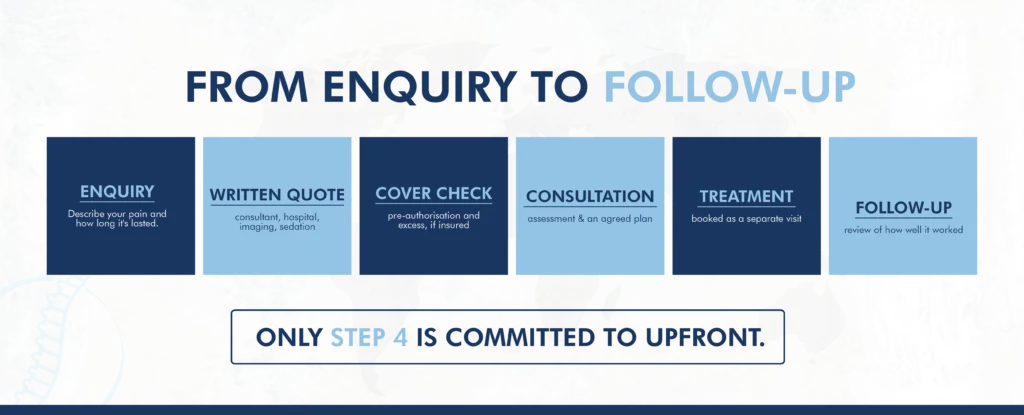
Start to finish, the pathway runs in six steps:
14. Enquiry: describe your pain and how long it’s lasted.
15. Written quote: consultant, hospital, imaging, and sedation.
16. Cover check: pre-authorisation and excess, if insured.
17. Consultation: assessment and an agreed plan.
18. Treatment: booked as a separate visit.
19. Follow-up: a review of how well it worked.
Is Private Pain Treatment Worth the Cost?
How Does NHS Care Compare with Private Care?
| NHS | Private | |
|---|---|---|
| Referral | GP referral into a local pain service; priority by clinical need | GP referral or self-referral; you choose your consultant |
| Wait time | Routinely weeks to months; some services report longer waits | Often days to a few weeks, depending on location and availability |
| Continuity | You may see different clinicians at different visits | Usually the same consultant for assessment, procedure and review |
| Cost | Free at the point of use | You pay per step, but gain speed and choice |
For many patients, the real question isn’t “which is better medicine?” It’s how much your time and continuity are worth, and whether you can afford to pay for them.
Is the Wait Worth Paying to Avoid?
That has measurable value when you’re waiting. In April 2026, NHS England recorded around 7.22 million cases on the referral-to-treatment list. The median wait was 11.9 weeks from GP referral to starting treatment. For someone in pain, that’s the difference between months of uncertainty and starting treatment within weeks.
How Do You Verify Dr Mehrez's Credentials?
Check the claims yourself, the same way you’d check any consultant’s. His GMC registration, No. 5171889, is verifiable on his Spire consultant profile. You can also check his Top Doctors profile and his individual PHIN consultant profile.
What's the Honest Bottom Line?
If your NHS pathway is already moving, there’s often no reason to change route. If you’ve been waiting while your sleep, mood, and mobility get worse, earlier assessment is worth paying for. If your pain turns out to need a medication review, not a procedure, the total cost may be one consultation.
FAQs
How much does a private pain consultation cost?
Consultation fees vary by site and consultant. PHIN’s own guidance gives a general range of £170 to £250 for an initial private consultation. Fees run higher in London and with senior consultants. For Dr Mehrez, you can check his self-pay consultation fee directly on his PHIN consultant profile. Still ask the clinic for a written quote before you book.
Does insurance cover pain management?
Often, but with conditions. Most policies require a GP referral and pre-authorisation before treatment. Chronic pain is one of the most commonly restricted categories, alongside pre-existing conditions and annual outpatient caps. Check with your insurer before booking.
What does self-pay include?
Whatever the written quote states, which is why it should itemise the consultant fee. It should list the hospital or facility fee, imaging, and sedation separately. Self-pay covers the steps you agree to, one at a time, with no policy conditions attached.
Are scans billed separately?
Yes. Imaging is charged by the hospital rather than the consultant, and appears as a separate invoice. Scans aren’t automatic either, because NICE advises against routine imaging for low back pain outside a specialist setting.
Do I need a GP referral for private pain treatment?
Paying for yourself, usually not for the consultation itself, though a diagnostic scan generally still needs one. Using insurance, yes, because your insurer needs the referral to authorise the claim.
Are payment plans available?
Finance arrangements depend on the hospital group hosting your appointment. Many private hospitals in the UK offer regulated finance plans, sometimes at 0% interest for a limited term. Providers such as Chrysalis Finance are common in the sector. Ask the clinic when requesting your written quote and confirm what’s available at that hospital.
What affects the final price?
Mainly the number of visits your pathway needs: complexity, whether a scan is needed, procedure type, and your follow-up schedule.
Is a procedure included in the first visit?
No, the first appointment is an assessment. Any procedure needs its own consent process and often sedation. It’s booked as a separate visit with its own quote.
Am I being sold treatment I don't need?
No. GMC guidance requires that treatment recommendations are driven by clinical need, never personal financial gain, with fees communicated transparently. Dr Mehrez follows the same NICE guidance an NHS consultant would use. If a scan or procedure isn’t clinically indicated, the honest advice is not to have it.
Book a Consultation with Dr Mehrez
Consultant in Pain Medicine since 2007. GMC No. 5171889. 107 Harley Street, London W1G 6AL, The Saxon Clinic, Three Shires Hospital, Spire Harpenden Hospital. Recognised by Bupa and WPA. Fee published on PHIN.
If your pain has lasted more than three months, one consultation can give you clear answers. You’ll learn what’s causing it, what it may need, and what it’s likely to cost.
If you’re not ready to book, Pain Concern and Live Well with Pain both offer free day-to-day support. PHIN lets you check published consultant fees before you decide. For a step-by-step walkthrough of the first appointment, see What Happens at a Pain Clinic in the UK.